
Hypoxic brain injury is like a box of chocolates. You never know what you’re gonna get.
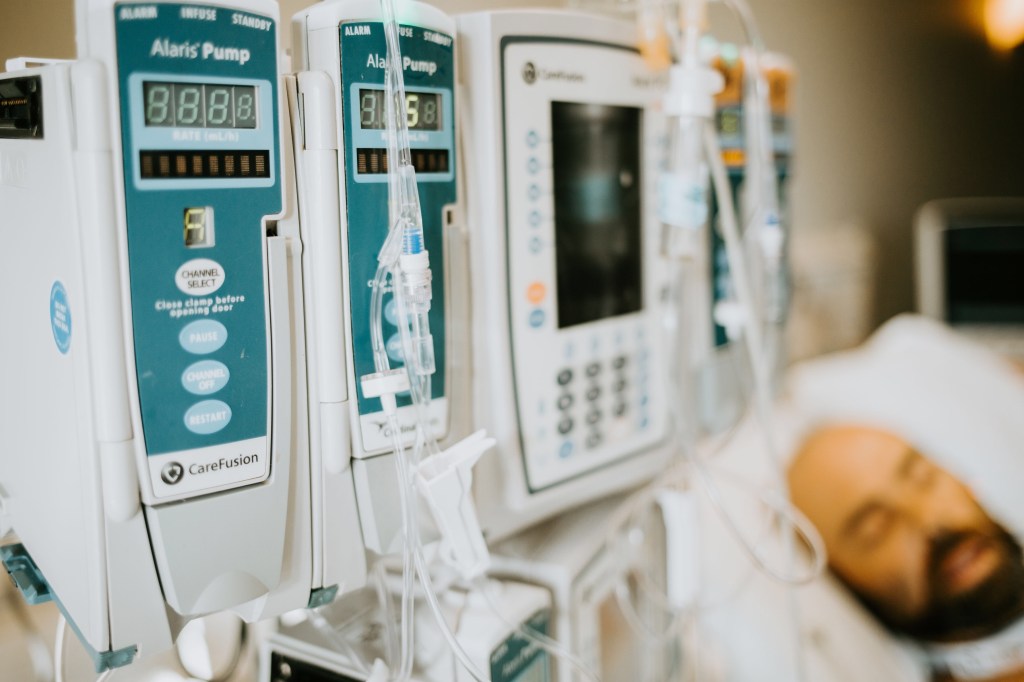
With a traumatic brain injury (like a car accident, or fall), it’s fairly easy to predict what type of deficits will present themselves, depending on what area of the brain was affected by the trauma. In Randy’s case, the whole brain was lacking oxygen, and the whole thing was damaged. He can have zero recovery, total recovery, and anything in between.
Randy’s flexor muscles are too tone. After several weeks without brain signals going to them, they began to fire off on their own. His fingers, wrists, elbows, shoulders, neck, hips, knees, ankles and toes are all in flexion. It’s worse on his left side. All day long, his muscles burn thousands of calories in constant spasm. It’s quite the workout and weight loss program.
There are prescription medicines that help to reduce tone, such as Baclofen, and others. Botox injections are also a common treatment, to locally inhibit part of the muscle’s ability to contract. Both have shown minimal benefit to Randy.
Often, a baclofen pump is surgically inserted into the abdomen, and a little drip hose (catheter) is run to the spine where very small amounts of the medicine drips on the cord, reducing the tone to the muscles associated with that level, (and often, all the levels lower than that one).
This kind of intervention has shown beneficial for those who have uncontrolled tone at multiple levels. The procedure is incredibly expensive, comes with lots of risk, and can fail to produce the desired effects, and need to be removed. It’s a big deal, and not something I’d like to do…if we have any other possible option for normalizing muscle tone.
Randy was scheduled for a trial of this treatment back in November, where, using a syringe, they would direct the medicine to the desired cord level and bathe the nerves there with baclofen, to see if it would reduce the tone enough to warrant the more permanent procedure of installing the pump.
It was discovered only days before the procedure, that Randy was on an anti-platelet therapy for his heart stents, that would make such a procedure too dangerous. The cardiologist who placed the stents said that removing Randy from the meds, even temporarily, would likely cause another heart attack very quickly. He also seems to feel that remains true for at least a year following the stent surgery. We’ve got to find another way to help Randy with these constant spasms, until at least August of 2020.
In Chiropractic, one of our main purposes is to facilitate the body’s natural mechanisms to speed healing and restore normal function. God wired our bodies in such a way that opposing muscles inhibit each other. For example, when you contract your bicep, your tricep is forced to relax, so that you can get movement into flexion at your elbow. Applying that principle, if I want Randy’s bicep to relax, I should stimulate contraction of the tricep. If I want the hamstring to relax so I can straighten out Randy’s knee, I should stimulate contraction of the quadriceps. But how?
Tune in next time for … some things we’re trying, to reduce Randy’s spasticity, improve his long-term outcome, and help him have more control over his own body.
 Follow Randy Home
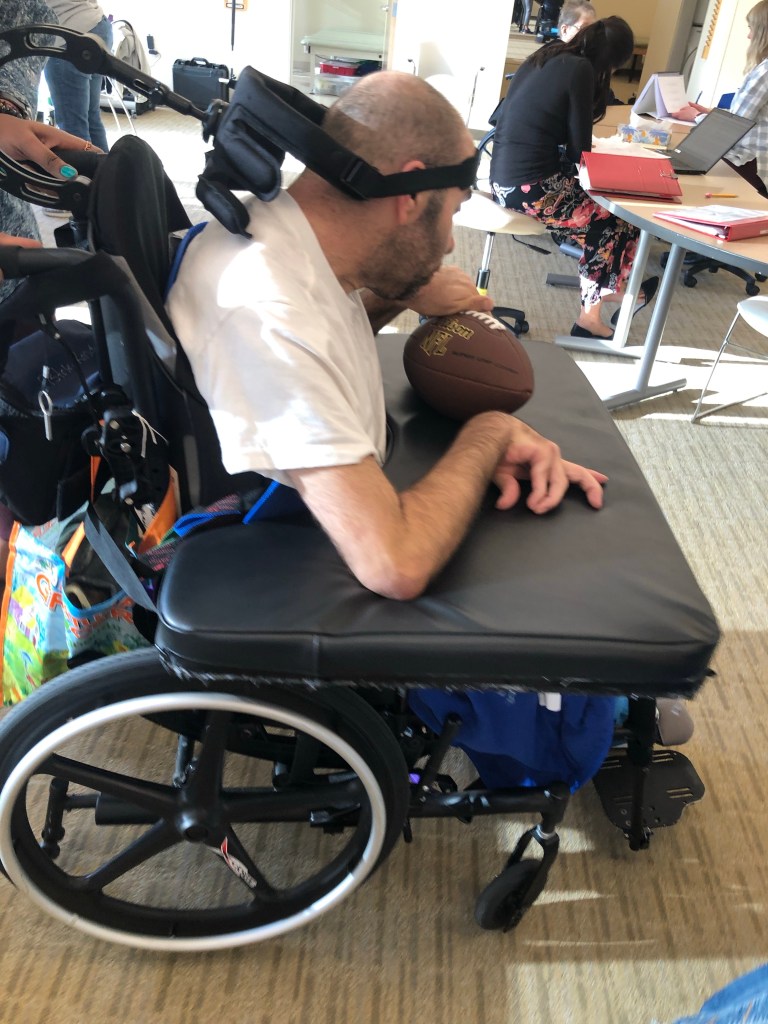
We continue to pray for Randy and family. Slow progress is still progress. Is he able to use a standing frame during the day? Does the Occupational Therapist use spring suspended slings to assist shoulder movement during treatment? Has a wheelchair that allows him to be reclined in seated position been considered so that his neck has some allowance for better position? Baclofen, as you discussed, was used when I worked with stroke patients which has been more than 10 years ago, now. I would think that a Neurologist would have some “cocktail” of this drug now. I looked up the cycle Randy is using in one of your recent posts. The “Motomed Muvi” I see they even have a version that can be used by the patient in bed (motomed letto2 (https;//enableme.com/products/reck-motomed/) ) I notice his picture in the wheelchair does not have support for the legs. Even with spasming, an “H-strap” that fits from legrest to legrest can keep his legs from falling off the footrests when you are taking him out of his surroundings. My last thought is a mirror on his lapboard—since he is not able to lift his head to see above him–it would help just like a rearview mirror//door mirror on a truck/car//even the rear view mirror that cyclers wear on their cycle helmets. Stay strong, dear lady. Keep your oil in your lamp at ultimate level. It is goooood to see him smile in the picture. Let him know it is uplifting to us so far away from y’all.
Thanks!! [http://gfx1.hotmail.com/mail/w4/pr04/ltr/emo/ids_emoticon_thumbsup.gif] Kate McKinley[http://gfx2.hotmail.com/mail/w4/pr04/ltr/emo/ids_emoticon_rose.gif] 254-982-4458 (H) 254-721-7758 (C)REMEMBER THE ALAMO!
________________________________
LikeLike
These are all wonderful ideas! I don’t think they’ve gotten him in the standing frame, here. Tilt table, bike, stretch on the therapy table is it for now. I’ll ask about these other ideas. Reclining hasn’t helped the head, he just flexes it more against gravity. I love the mirror and leg strap ideas. I can do those, myself!
LikeLike